
Bullet Speed vs. Armor: How Distance Changes Everything
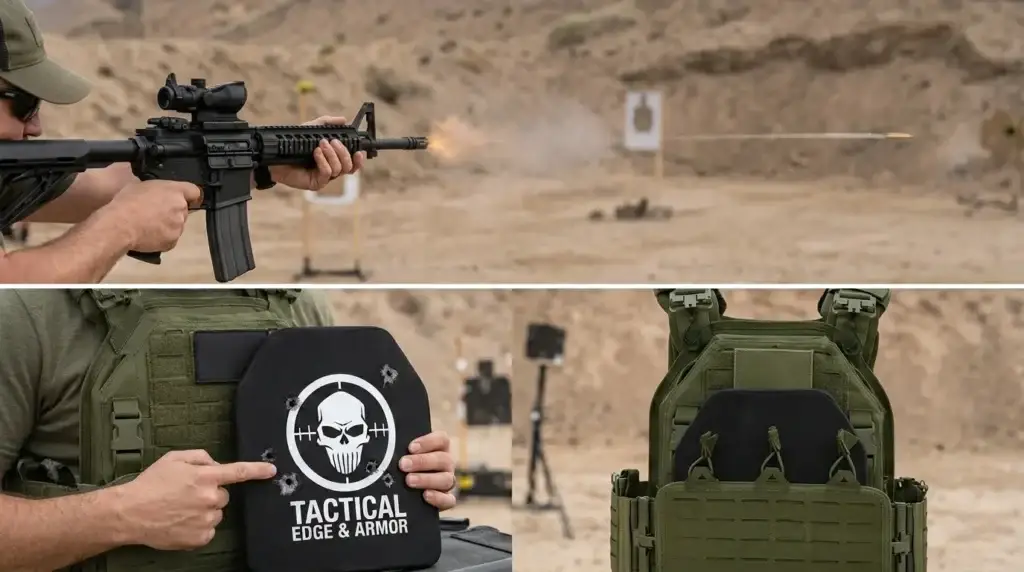
Understanding how distance affects bullet speed—and how body armor responds—is critical for tactical planning, personal protection, and gear selection. At its core, the ballistic relationship is simple:
- Greater Distance = Decreased Velocity: The farther a projectile travels, the more it slows down.
- Lower Velocity = Less Kinetic Energy: A slower impact reduces the bullet’s ability to defeat armor systems.
But the real-world physics of ballistic protection require a deeper look.
Understanding Kinetic Energy in Ballistics
A projectile’s ability to penetrate body armor is driven by two primary variables: velocity (speed) and mass (projectile weight). To understand the threat level, we look at the kinetic energy formula:
Kinetic Energy = ½ x mass x velocity²
Because velocity is squared in this equation, even a minor drop in speed results in a dramatic reduction in impact energy. This calculation dictates National Institute of Justice (NIJ) armor ratings, which test body armor plates against specific velocities.
Why Do Bullets Lose Speed Over Distance?
The moment a projectile leaves the barrel, environmental and aerodynamic forces begin degrading its velocity. This slowdown is dictated by:
- Atmospheric Drag (Air Resistance): The primary force slowing the round.
- Ballistic Coefficient (BC): The aerodynamic efficiency of the bullet shape.
- Environmental Variables: Air density, altitude, temperature, and humidity.
The Velocity Drop: 5.56 NATO Example
- Muzzle Velocity: A standard 5.56×45mm NATO round exits a rifle barrel at over 3,000 fps (feet per second).
- At 100 Yards: The round retains high velocity and lethal penetration capabilities.
- At 300+ Yards: The round experiences a significant velocity drop, mitigating some of its armor-defeating potential.
Heavier, streamlined rifle bullets retain energy better at long ranges than lighter or poorly shaped handgun bullets, but every yard traveled takes a toll on performance.
How Distance Impacts NIJ Armor Levels
Body armor isn’t rated universally; plates are certified to stop specific calibers at precise impact velocities.
| NIJ Armor Level | Primary Threat Profile | Distance / Velocity Impact |
| Level II / IIA | Common handguns (9mm, .357 Mag) | Handgun rounds start slow and lose energy rapidly over distance. |
| Level IIIA | High-velocity handguns (.44 Mag) | Soft armor protection; vulnerable to close-range rifle threats. |
| Level III | Rifles (7.62mm FMJ / 5.56mm) | Hard plates; intermediate rifle rounds lose penetration power at extended ranges. |
| Level IV | Armor-Piercing (AP) Rifles (.30-06 AP) | Highest protection; designed to stop hardened steel cores at test velocities. |
The “Drop Down” Threat Phenomenon
Distance can effectively downgrade a threat. A high-velocity rifle round capable of defeating a specific plate at 25 meters may fail entirely at 200 to 300 meters because its velocity has dropped below the critical penetration threshold. This is a vital factor when evaluating hard armor plates against intermediate calibers like 5.56×45mm or 7.62×39mm.
Tactical Implications: Close Range vs. Long Range
Close-Quarter Engagements (Maximum Velocity)
- The Threat: Projectiles strike near maximum muzzle velocity, maximizing penetration potential. Even lower-mass, high-velocity rounds can be incredibly punishing to armor.
- The Armor Response: Hard armor plates are tested at close range to simulate these absolute worst-case scenarios.
Extended Distance Engagements (Reduced Velocity)
- The Threat: Velocity drops, and even armor-piercing (AP) rounds may eventually lack the kinetic energy to compromise quality plates.
- The Remaining Risk: While penetration risk decreases, Backface Deformation (BFD) and blunt force trauma remain serious safety concerns. A stopped bullet can still fracture bones or cause internal bleeding.
How Projectile Design Changes the Equation
Not all bullets slow down or interact with armor plates the same way:
- Full Metal Jacket (FMJ): Maintains its structure upon impact, creating focused, concentrated energy to punch through targets.
- Hollow Point: Engineered to expand rapidly in soft tissue. Against hard armor, these rounds typically deform or shatter instantly.
- Armor-Piercing (AP): Features a hardened core (such as steel or tungsten). Because of this construction, AP rounds can still penetrate armor at much lower velocities than standard FMJ ammunition.
Strategic Guide for Body Armor Selection
When evaluating armor specification sheets from specialized industry sources like tacticaledgeandarmor.com, looking past the basic NIJ label is critical. Factor these three variables into your purchase:
- Environmental Threat Profile: Are you preparing for close-quarters handgun threats or open-terrain rifle threats? Match your gear to the most realistic engagement distances.
- Velocity Margin of Safety: Does the plate barely meet the minimum NIJ test velocity, or does it offer a performance buffer? Premium manufacturers design plates to handle multi-hit stress beyond baseline requirements.
- Deformation Metrics: Review backface deformation charts. Ensure your choice minimizes blunt force injury at various engagement distances, even if the round is successfully stopped.
Final Thoughts
As distance increases, bullet speed, kinetic energy, and penetration potential decrease. While distance acts as a natural buffer, it does not magically make under-rated armor effective against severe threats. Real-world protection requires matching your armor selection to realistic threat profiles, specific impact velocities, and your unique operational environment.