
How to Balance Body Armor Weight and Protection Levels
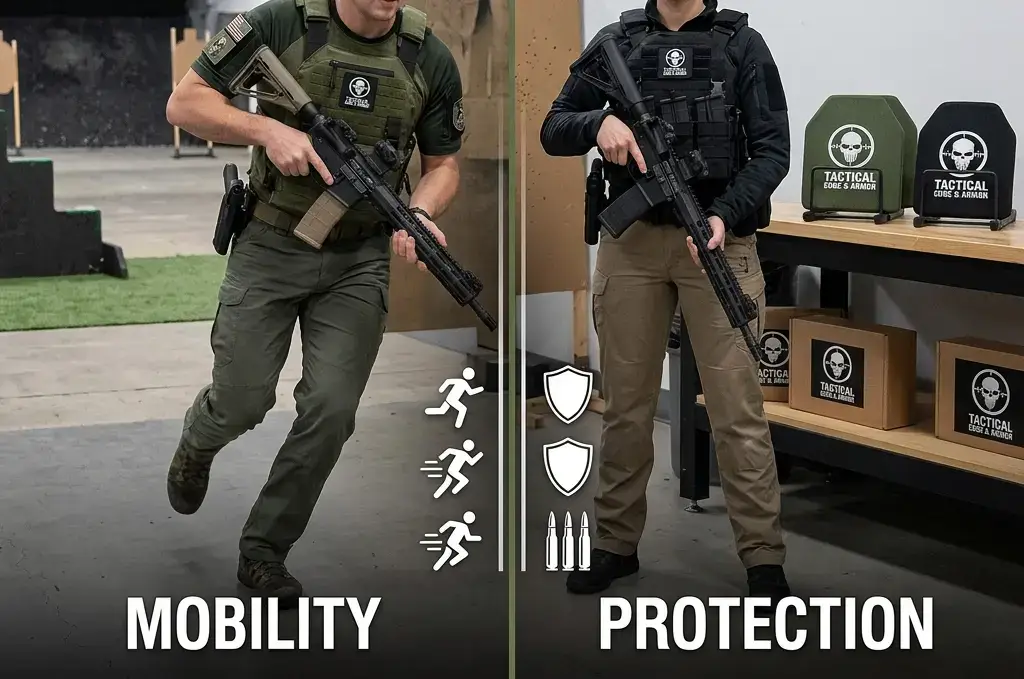
Finding the right balance between weight and protection in body armor is one of the most critical—and most misunderstood—decisions you can make. This applies whether you are in law enforcement, the military, private security, or a prepared civilian.
Too many people focus exclusively on “highest protection at any cost” or chase the “lightest plate possible.” In the real world, choosing either extreme can actually make you less safe.
Here is how to evaluate your options to maximize your true survivability.
Why “Maximum Protection” Isn’t Always Safest
On paper, Level IV ceramic plates or heavy steel plates look like the obvious choice because they stop powerful rifle rounds. However, heavy armor carries severe real-world penalties:
- Fatigue drains your awareness: Extra weight means faster exhaustion. Fatigue leads to slower reaction times, poorer decision-making, and reduced situational awareness during an active incident.
- Mobility is a form of protection: If your armor is so heavy that you cannot sprint, clear stairs, get behind cover, or go prone quickly, you have sacrificed your most vital defense: mobility.
- The “trunk factor”: If your armor is agonizingly heavy, you will eventually leave it behind. Armor sitting in your vehicle provides exactly 0% protection when an emergency happens.
The Survival Equation: Maximum rating does not equal maximum survivability. True safety sits at the sweet spot between sufficient protection and realistic mobility.
The Pitfalls of Ultra-Light Body Armor
On the flip side, minimalist, ultra-light plates feel fantastic to wear, but they often require dangerous trade-offs:
- Threat limitations: Many ultra-light options are only rated for pistol threats (like Level II or IIIA soft armor). If your environment contains intermediate rifle threats, soft armor isn’t enough.
- Velocity vulnerability: Not all “rifle-rated” plates are built the same. Special threat plates or lightweight Level III options are designed for specific calibers at specific velocities. You must match your armor to likely regional threats, not just generic “rifle” categories.
Defining Your Mission-Appropriate Balance
The ideal armor setup depends entirely on your specific operational profile:
1. Patrol Officers & Security Personnel
You work long, unpredictable shifts, moving in and out of vehicles and traversing indoor/outdoor environments.
- The Sweet Spot: High-quality Level III or “special threat” plates. These stop common intermediate rifle rounds (like 5.56 or 7.62×39) without the crushing weight penalty of standard Level IV plates. Pairs best with a weight-distributing carrier.
2. Tactical Teams & High-Risk Warrant Service
You are aggressively clearing spaces, stacking on doors, and maneuvering in tight quarters under high stress.
- The Sweet Spot: You will need to accept heavier, higher-rated plates (Level IV) to mitigate close-range threats. However, this weight must be balanced by high physical conditioning and a streamlined gear loadout.
3. Civilian Home Defense & Emergency Preparedness
You aren’t wearing this gear for 12 hours a day, but you need to be able to don it in seconds to defend your home.
- The Sweet Spot: Rapid-donning plate carriers with lightweight plates rated for common regional rifle and pistol threats. It must be light enough that you can still navigate your home and utilize cover effectively.
4 Questions to Ask Before Buying Body Armor
Before investing in a system, put it through this practical evaluation:
- What threats am I most likely to face? Match your armor to your realistic threat environment (e.g., handgun rounds in urban settings vs. rifle calibers in rural areas).
- How long will I actually wear this? Shaving even two pounds off your torso drastically improves long-term endurance if you wear armor for hours at a time.
- Can I move, fight, and think in this setup? Test your full kit (plates, mags, medical, radio) by sprinting 50 yards and moving from kneeling to prone. If you can’t move fluidly, your balance is wrong.
- Will I wear it consistently? If you find yourself making excuses to leave it behind, your system is too heavy.
Optimizing Your Protective System
This is where working with specialized providers like Tactical Edge and Armor becomes invaluable. Because armor isn’t one-size-fits-all, a dedicated provider helps you optimize your gear beyond the sales sheet:
- Plate Cut Selection: Choose between SAPI, shooter’s, or swimmer’s cuts to maximize your specific range of motion and arm clearance.
- Loadout Distribution: Learn to pair your plates with the right carrier padding and cummerbund adjustments to eliminate hot spots and friction points.
- A “System” Mindset: Remember that your fighting weight is a combination of plates, carrier, ammo, and medical gear. Keep the entire ecosystem streamlined.
The Bottom Line: Don’t just ask a shop, “What is your strongest plate?” Instead, tell them your role, your likely threats, and your typical shift length. The right armor choice will always prioritize your ability to move, think, and fight back. Shop your armor at Tactical Edge & Armor