
Ballistic Resistance of Body Armor, NIJ Standard 0101.07
Understanding NIJ Standard 0101.07 Requirements for Body Armor
This National Institute of Justice (NIJ) publication, Ballistic Resistance of Body Armor, NIJ Standard 0101.07, specifies minimum performance requirements and test methods for the ballistic resistance of body armor used by U.S. law enforcement that is intended to protect the torso against handgun and rifle ammunition. It is a revision of National Institute of Justice (NIJ) Standard 0101.06, Ballistic Resistance of Body Armor, published in 2008.
Primary Purpose Standard
The primary purpose of this standard will be for use by the NIJ Compliance Testing Program (CTP) for testing, evaluation, and certification of ballistic-resistant body armor. It will also be used by ballistic testing laboratories and body armor suppliers participating in the NIJ CTP. This standard will be included in the Law Enforcement and Corrections Equipment Laboratory Accreditation Program (LAP) of the National Voluntary Laboratory Accreditation Program (NVLAP) to accredit ballistics laboratories.[2]
Ballistic Threat Level Changes
The ballistic test threats are no longer listed in NIJ Standard 0101.07 as in past revisions of the standard. These have been moved into Specification for NIJ Ballistic Protection Levels and Associated Test Threats, NIJ Standard 0123.00, which is a new standalone document that defines ballistic threats identified by U.S. law enforcement as representative of current prevalent threats in the United States.
NIJ Standard 0123.00 was designed be used in conjunction with other standards like NIJ Standard 0101.07 to test and evaluate specific ballistic-resistant equipment, such as ballistic- resistant body armor, against contemporary ballistic threats that pose a life-threating safety hazard to U.S. law enforcement officers. The test projectiles and reference velocities in the inaugural version of NIJ Standard 0123.00 have been updated from section 2 of NIJ Standard 0101.06 to reflect the current threats faced by U.S. law enforcement end users, including a wider range of rifle threats.
Protection level nomenclature has also been moved into NIJ Standard 0123.00 and has been revised to be more descriptive of threats and to reduce confusion for users of body armor, see Table 1.
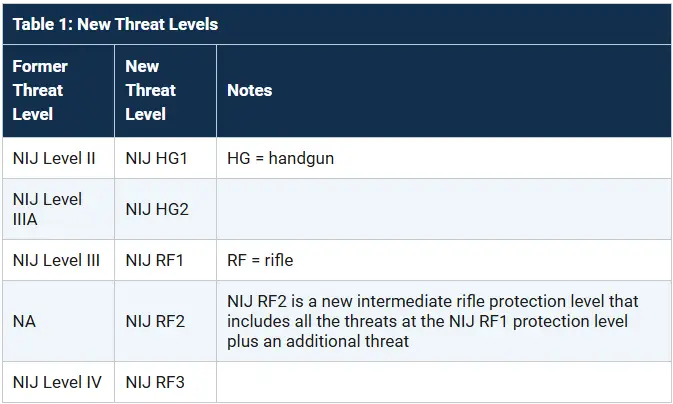
NIJ Standard 0101.07 references the new ballistic protection levels in the inaugural version of NIJ Standard 0123.00 rather than defining the levels within NIJ Standard 0101.07 itself, as was done in NIJ Standard 0101.06 and previous versions.
Improved Test Methods for Armor Designed for Women
Fourth, this standard contains improvements to the test methods for armor designed for women, including new clay appliques (e.g., build-up of clay) to ensure better contact of nonplanar panels with the clay backing material and new shot requirements to assess shaping features. Shot placement has also been reconfigured to exploit potential vulnerabilities due to unique construction elements in the panel and nonzero angles of incidence in the proximity of edges.
mplementation of this laboratory practice proved more challenging than expected, including difficulty creating the specific applique shapes described in ASTM E3086 and ensuring proper contact with the armor panel once mounted on the clay block. These challenges required reconsideration of how to build up clay behind nonplanar soft armor panels. A more simplified applique was developed to ensure that the panels are fully filled in with clay before mounting on the clay block. This applique is more monolithic in form and better supports armors designed for female wearers during testing. It is created using one of two standardized mold sizes along with a procedure to shape its form once affixed to the clay block. The result is a better substrate to ballistically test nonplanar armor, replacing the procedure in ASTM E3086. The electronic files containing the drawings of the molds to make the clay appliques described in Appendix G are freely available to NIJ-approved testing laboratories and other organizations upon request.